
How to Check Criminal History in Taylor County
Taylor County has no single public database that holds every criminal record. Begin with the event you need to verify. Guest CourtNet can show public case and event information, but the Taylor Circuit Court Clerk keeps the official District and Circuit Court files. The Taylor County Detention Center answers current custody questions. Kentucky State Police maintains the central criminal-history repository, while the Administrative Office of the Courts sells statewide court-activity reports through FastCheck and One-Time Request. Each source has a different scope.
Gather a full legal name, birth date, known aliases, the approximate event date, and a case number when available. Similar names can produce false matches. Kentucky case codes also matter: T marks traffic, M marks a misdemeanor, F marks the District Court stage of a felony charge, and CR marks a Circuit Criminal case after indictment or direct filing.
- Search Guest CourtNet for public case or event information, using Taylor as the jurisdiction and the strongest lawful identifiers available.
- Review the case class, county, charge dates, and party details instead of relying on the name alone.
- Call or visit the Taylor Circuit Court Clerk for the docket, filed orders, disposition, or an older record that is not online.
- Check the detention center for very recent custody and KOOL after a transfer to state custody or supervision.
- Use KSP or AOC when an official statewide product fits the purpose, and keep the county court file as the source for signed orders.
The Kentucky Court of Justice background-check page illustrates the AOC record route.
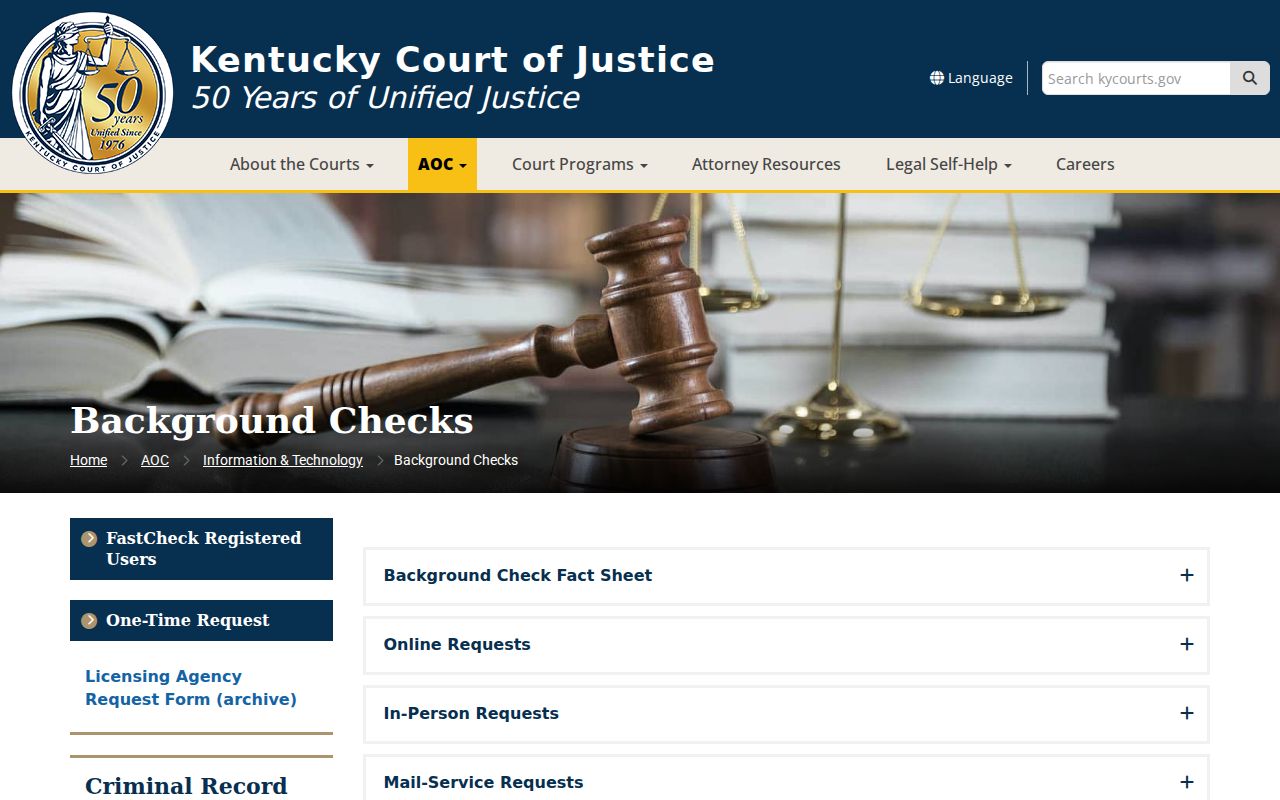
That screen is an entry point for a statewide court report, not a certified Taylor County judgment.
Taylor County Criminal Case Records Counter
The local records landscape has two government buildings with different jobs. The Office of Circuit Court Clerk is inside the Taylor County Judicial Center at 300 E. Main St., Campbellsville. It manages both Taylor Circuit Court and Taylor District Court files, despite the office title. Felony cases belong in Circuit Court. District Court handles misdemeanors, traffic, city ordinance charges, and the first stage of many felony matters. The county courthouse on North Court Street houses county offices, including the sheriff, but it is not the clerk's criminal case counter.
Taylor Circuit Court Clerk
300 E. Main St.
Campbellsville, KY 42718
270-465-6686
Monday through Friday, 8 a.m. to 4:30 p.m.
Taylor County Sheriff
203 N. Court St., Suite 7
Campbellsville, KY 42718
270-465-4351
Weekdays, plus Saturday morning hours
The official Taylor County court page shows the Judicial Center and clerk contact.
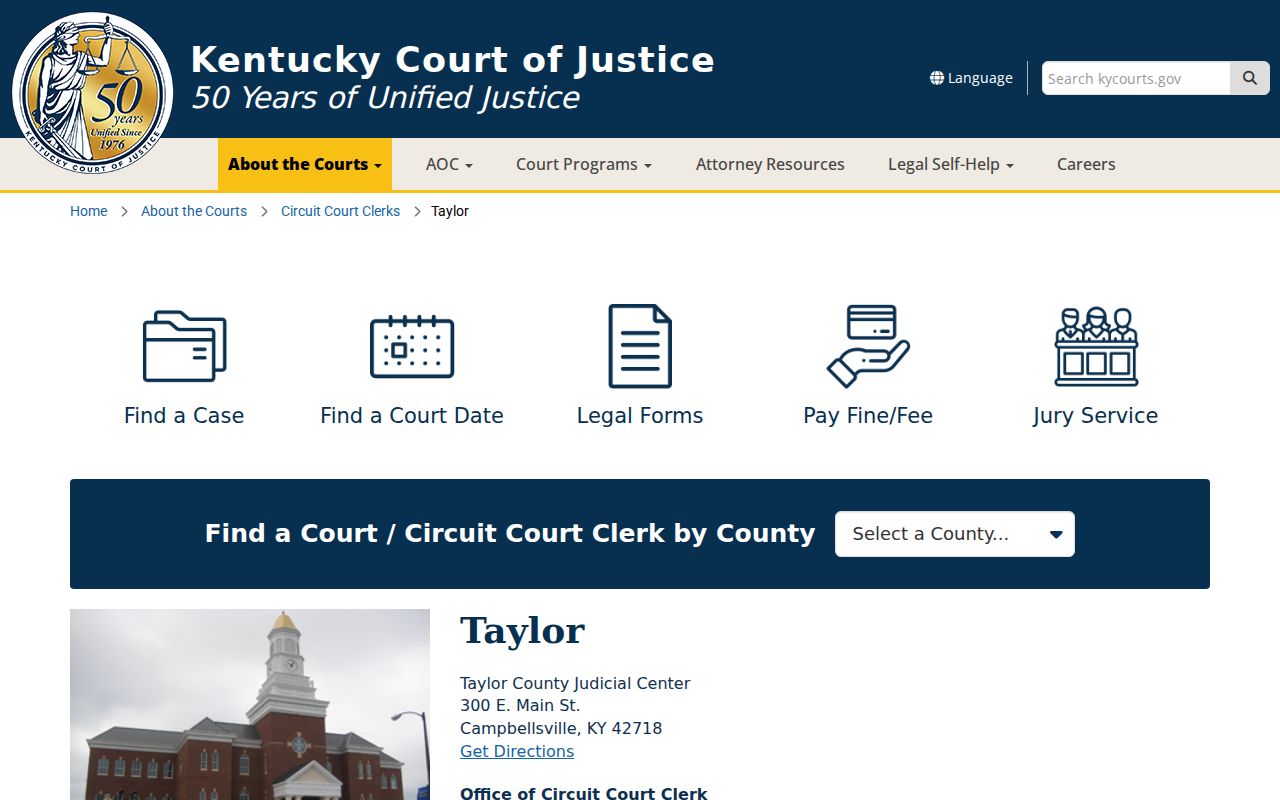
The court page also lists payment methods and current division information, which should be checked before a visit.
Older records may be off-site or subject to a retention schedule. When a file remains at the State Records Center, first ask the clerk for its case and file locator numbers. The storage center cannot perform a name search for the reader. A remote hearing link also does not create public permission to attend; the 11th District local rules and the court control remote access.
Official Kentucky Background Checks
Kentucky State Police and the Administrative Office of the Courts issue different Taylor County record products. KSP's general public name-based check searches its centralized repository. It costs $20, requires the adult record subject's permission, uses no fingerprints, and is submitted by mail or walk-in. KSP says mailed Taylor County requests average ten business days. This is not an unrestricted instant name-search portal.
The AOC product reports Kentucky District and Circuit Court activity from all 120 counties, including Taylor County. It can include county of origin, case number, original and amended charges, disposition, relevant dates, and clerk memos. It omits federal records, confidential case types, and expunged or purged cases. AOC labels the result “Not an Official Court Record,” so signed pleadings and orders must still come from the Taylor Circuit Court Clerk.
The KSP background-check instructions describe the consent-based repository process.

The instructions make the permission rule and offline ordering route clear.
Taylor County Criminal Record Products
FastCheck is AOC's registered-user channel for a statewide report that can include Taylor County. A requester can see a pending item marked Processing, receives notice when it is ready, and can retrieve the report online for 30 days. One-Time Request accepts a single order, sends the result by U.S. mail, and offers no online status check. AOC does not expedite either route. When a request about another person returns a record, AOC says the subject is notified and receives a copy.
| Product | Best use | Main limit |
|---|---|---|
| Guest CourtNet | Public case and event clues | Not the signed official file |
| AOC report | Statewide Kentucky court activity | No federal or confidential cases |
| KSP name check | Consent-based repository check | Mail or walk-in, subject permission required |
| FBI self-review | One's own nationwide identity history | Fingerprint-based personal process |
The AOC public request menu shows the online order choices.
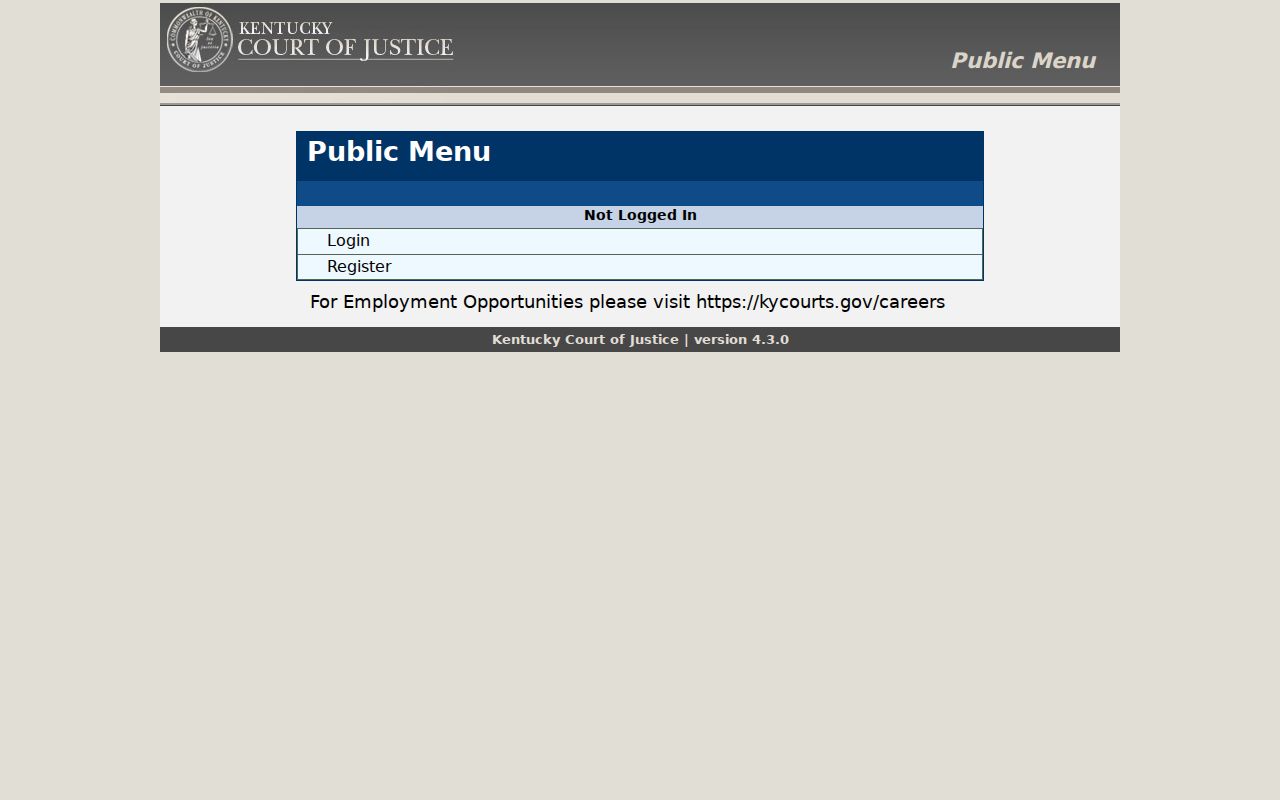
The menu routes requests, but the Taylor County clerk remains the source for certified copies.
KSP publishes the forms required for a Taylor County repository check.

Using the correct form prevents a repository request from being confused with an AOC court report.
Taylor County fingerprint checks through IdentoGO are limited to agencies or organizations with statutory authority. A Kentucky resident reviewing an FBI identity history can use the FBI self-review route, selecting the enrollment service the receiving process requires. A local law-enforcement print site may charge up to $10 in addition to other program fees.
The IdentoGO enrollment page begins the approved fingerprint capture process.
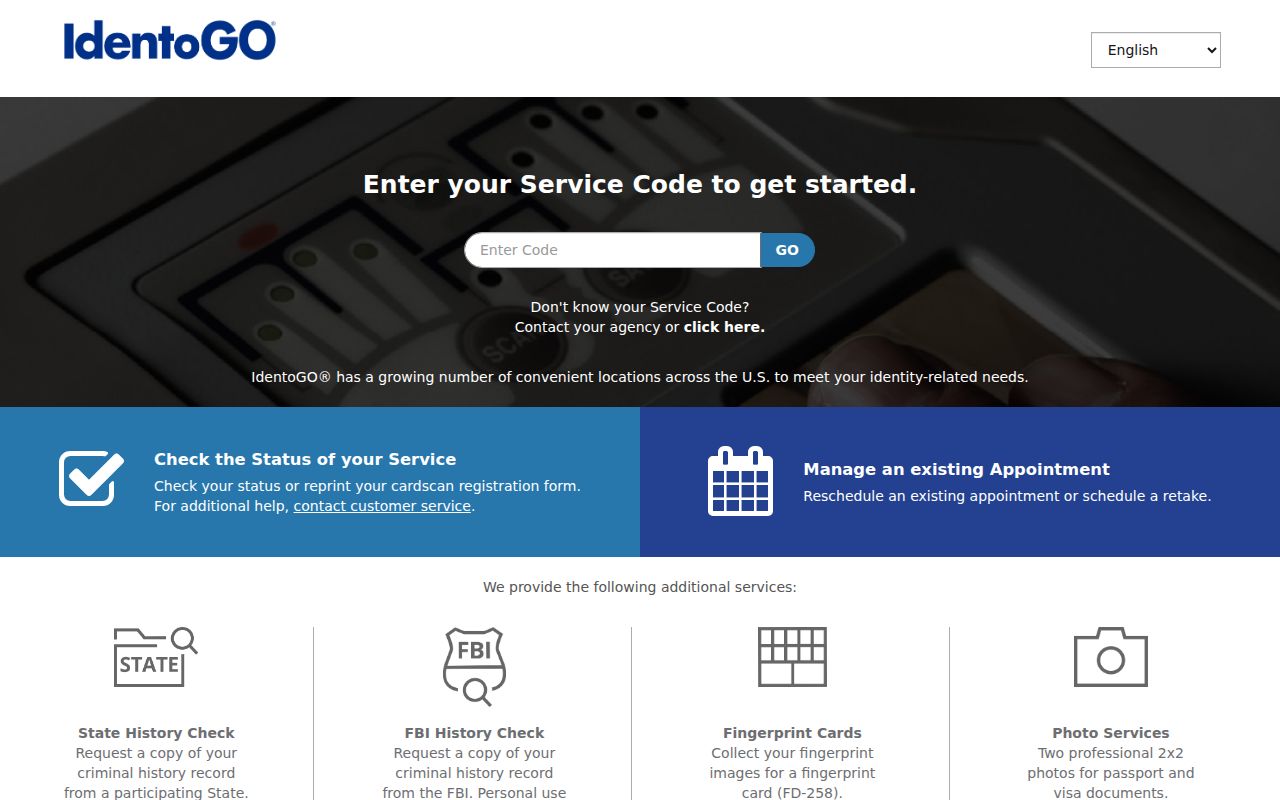
Applicants should obtain the correct service code or instructions from the authorized requesting agency before enrolling.
Types of Criminal Records
“Criminal record” can refer to several Taylor County files that are created at different times. The arresting agency writes the incident or arrest narrative. The detention center creates the booking and current-custody record. The clerk maintains the court file, including charges, motions, orders, and the final disposition. KSP compiles identity-linked submissions into the statewide repository. Kentucky Corrections tracks state custody and supervision, while the sex offender registry covers only people with a statutory duty to register.
- Police and sheriff reports: describe the call, alleged conduct, officer action, and available attachments.
- Booking records: document intake, custody, received charges, bond, and release status.
- Court files: show filed charges, docket events, orders, pleas, judgments, and sentences.
- Repository histories: connect identity, fingerprints, arrests, charges, and reported outcomes.
- Corrections and registry entries: answer narrower custody, supervision, or registration questions.
A Taylor County warrant has its own split. A judge issues it in a court matter, while law enforcement tracks service and execution. Taylor County has no verified complete public warrant database. Anyone resolving a possible warrant should contact the responsible court or law-enforcement office directly rather than relying on silence from an online search.
Taylor County Arrest and Custody Trail
A Campbellsville arrest can produce several records within hours. The police report remains with the arresting agency. Taylor County Detention Center creates a booking entry after delivery. A citation or complaint can start a District Court case. If a felony proceeds by indictment, a related CR case appears in Circuit Court. Fingerprints and later dispositions flow to KSP through separate reporting steps. These files can disagree for a time because each custodian records a different stage.
Incident or arrest report → jail booking → District Court filing → Circuit Court felony case when indicted → final disposition reported to state systems
The detention center at 120 S. Central Ave. can answer current booking, bond, and release questions at 270-789-1909. Its record does not establish guilt. A prosecutor may amend a received charge, decline it, or proceed under another count. After transfer to state custody, the county roster may no longer show the person even though the court case remains. Kentucky Online Offender Lookup is the next place to check for covered state custody or supervision.
An arrest or booking entry is an allegation and custody event, not proof of conviction. Read the clerk's final order before drawing a conclusion.
What a Taylor County Criminal Record Shows
The fields depend on the product. An AOC report centers on cases. A KSP history centers on identity and event cycles. KOOL centers on custody and supervision. The Taylor County court file centers on documents. Strong matching uses more than a name, and public results should never expose or repeat private identifiers such as Social Security or driver's-license numbers.
| Name and identifiers | Legal name, aliases, birth date, and agency identifiers as the product lawfully displays them. |
|---|---|
| Arrest and booking data | Arresting agency, intake date, received charges, bond, custody, and release information. |
| Charges and statutes | Original counts, later amendments, offense level, and cited Kentucky law. |
| Disposition | Dismissal, plea, conviction, acquittal, or another court result, with a date when reported. |
| Sentence | Custody term, fine, probation, or other terms stated in the judgment. |
| Custody or supervision | Current location or probation and parole status when the relevant public system includes it. |
One prosecution may show both an F case and a CR case. That is not necessarily a duplicate. The F case marks the District Court felony-charge stage; CR marks the Circuit Criminal case after indictment or direct filing. Read charge amendments and the final disposition, not just the first accusation.
Reading Taylor County Criminal Case Data
Official Taylor County analytics also need context. CourtNet's specified-charge reports count charges within filed cases, not convictions or unique people. One case can contain several charges, and the same person can appear in more than one case. Taylor figures in those reports are snapshots of filings. They cannot support a claim about personal guilt or a general crime rate.
- Charge
- An accusation filed under a cited law. It is not the outcome.
- Disposition
- The court's result for a count, such as dismissal, acquittal, plea, or conviction.
- Docket
- The chronological list of filings, hearings, and court actions in a case.
- Certified copy
- A copy authenticated by the clerk, distinct from an online summary.
If a current search does not show an older matter, call the clerk. A record may be off-site, destroyed under an authorized schedule, confidential, purged, or expunged. For an available off-site file, the clerk supplies the locator data needed by the State Records Center. Online absence alone does not identify which reason applies.
Public Access Laws
The Kentucky Open Records Act governs requests to public agencies such as police and sheriff offices, subject to exemptions. Court records follow judicial rules, so a general open-records letter is not the normal route to a Taylor County case file. KRS Chapter 17 adds limits for criminal-history, intelligence, and investigative information. Juvenile police and court records receive separate confidentiality protection.
Key statutes and rules:
KRS 61.870 through 61.884 creates public-agency inspection rights while preserving stated exemptions.
KRS 17.150 and 17.151 govern law-enforcement records and KSP's centralized criminal-history system.
Administrative Order 2022-65 sets CourtNet access policy and limits confidential-case access.
KRS 610.320 and 610.340 protect juvenile police, court, and docket information, subject to defined exceptions.
A narrow Taylor County agency request should identify an existing record, its likely date, place, incident number when known, and the preferred format. The sheriff has no verified dedicated online form, so a signed written request can be sent to its published contact. An agency may redact protected victim, juvenile, medical, personal, or active-investigation material and should state the legal basis for withholding.
Taylor County Criminal Record Expungement
Expungement begins with an eligibility certification built from AOC and KSP data. The certification costs $40 and expires after 30 days. It must be filed with the correct petition in the county where the charge or conviction occurred. For a Taylor County matter, filing goes to the Taylor Circuit Court Clerk. The certificate alone does not clear a record; relief comes from a judge's order.
The Kentucky Court of Justice expungement page explains certification and petition steps.
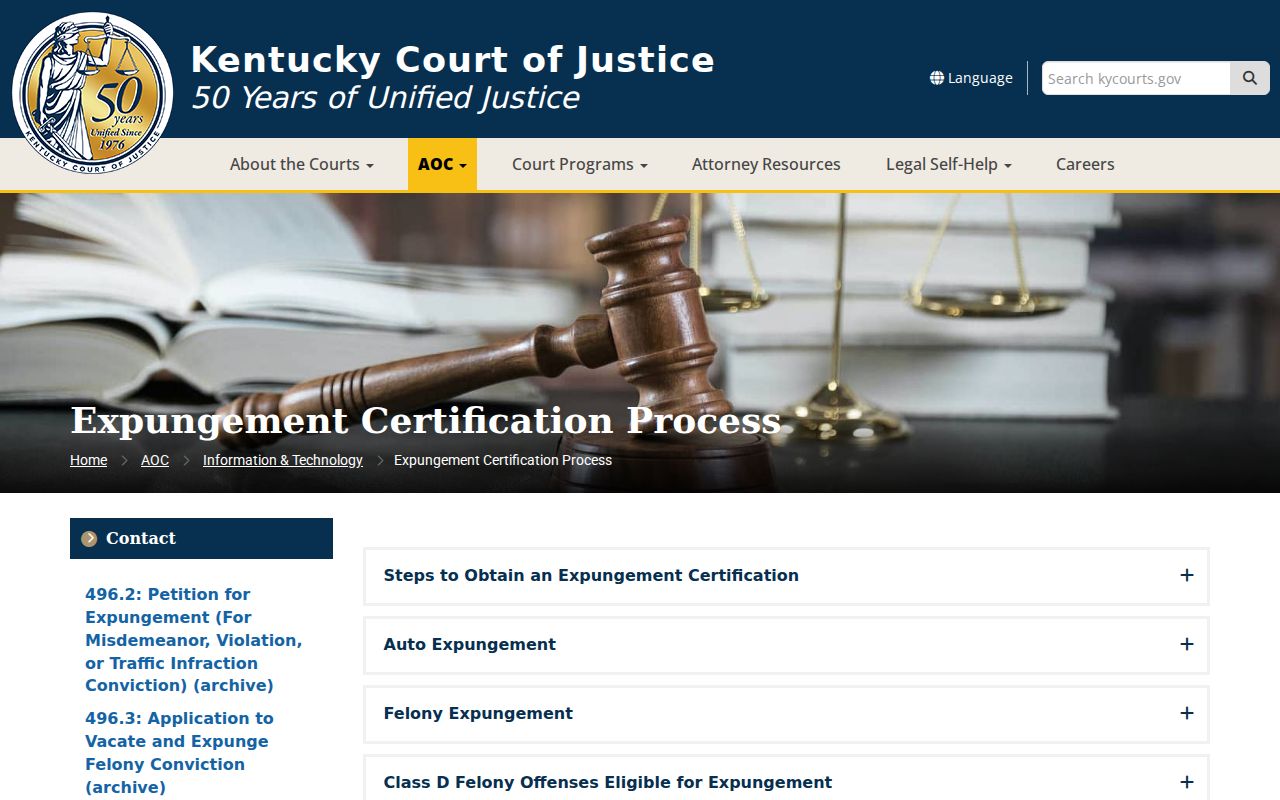
The official instructions distinguish the certification request from the later county filing.
Eligible Taylor County outcomes follow different rules. Some acquittals and dismissals with prejudice entered on or after July 15, 2020 receive automatic processing after 30 days unless the person objects. Dismissals without prejudice have longer waits. Eligible misdemeanor convictions generally require five years after the sentence or successful probation ends, whichever is later. Only listed eligible felony convictions qualify under the vacate-and-expunge route, which has separate petition and payment requirements.
| Item | Published amount |
|---|---|
| Eligibility certification | $40 |
| Eligible felony filing portion | $50, nonrefundable |
| Eligible felony balance after approval | $250 |
| KSP public name check | $20 |
Sealed, Expunged & Restricted
Kentucky uses expungement as the ordinary adult record-clearing term. Restricted material also includes juvenile records, confidential mental-health and domestic-violence case types, protected victim information, personal financial identifiers, and portions of active investigative files. AOC statewide reports omit confidential and expunged or purged cases. Public search results therefore are not a complete archive of every justice-system contact.
After a Taylor County expungement order, affected agencies remove or delete the eligible matter from public-facing official systems as required. A prosecutor may retain a limited nonpublic law-enforcement record, and AOC retains limited information needed for later eligibility certification. Keep a certified order. If an official report still shows the case after processing time, send the signed order and identity details to the relevant records unit or clerk.
“Dismissed” and “expunged” are not synonyms. A dismissal is a case result. Expungement is a later statutory process or qualifying automatic action that changes public visibility. Until that process applies and is completed, a dismissed count may remain visible with its dismissal disposition.
Taylor County Corrections Record Layer
Kentucky's corrections records answer another narrow question. The Kentucky Department of Corrections runs KOOL, which can show covered state custody or community-supervision information. Taylor County Detention Center records concern local booking, pretrial custody, and qualifying local sentences. A person transferred out of the county jail may appear through KOOL instead. Neither source replaces the clerk's judgment and docket.
Probation and parole are also distinct. A Taylor County judge may order probation, while the state Division of Probation and Parole supervises covered cases through numbered districts. The Kentucky Parole Board makes release decisions, and the DOC division handles community supervision. Detailed notes and private supervision information are not the same as a public judgment or locator entry.
The Kentucky Probation and Parole page describes the state-run supervision structure.
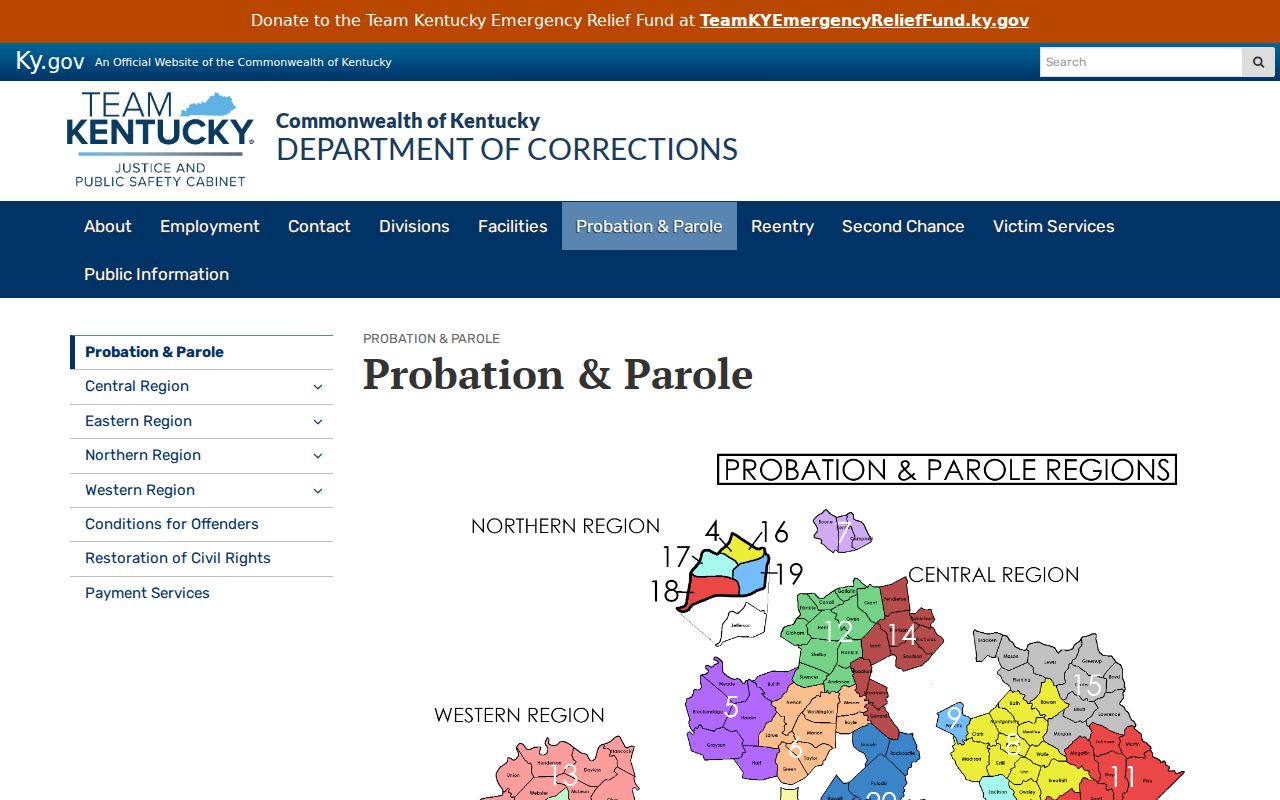
The state page helps route supervision questions, while Taylor County court orders remain with the local clerk.
Federal records form a separate layer. Federal cases arising in Taylor County belong to the U.S. District Court for the Western District of Kentucky and use PACER for filed case material. Federal custody uses the Bureau of Prisons locator. A Kentucky AOC report excludes federal matters, so the lack of a state-court entry says nothing about federal court history.
Criminal Records by City in Taylor County
Campbellsville is Taylor County's only incorporated city. Its police department creates city incident and arrest reports, but it does not run a separate municipal criminal court or jail. A Campbellsville police report is requested through the city's signed open-records process. A detained person is routed through Taylor County Detention Center, and criminal city-ordinance, misdemeanor, traffic, and felony case files go to Taylor District or Circuit Court.
Campbellsville Criminal History
Population estimate 11,783 · City police records split from county booking and court files
City Hall receives signed Campbellsville records requests in person, by mail, or by email. On-site inspection is free. The city publishes charges of $0.10 per page, $5 per CD, plus mailing, with payment before release. A request should clearly name the incident report, dispatch record, video, or other existing record and give the date, location, and report number when known.
Taylor County Criminal Records Geography
Taylor County was created in 1848, and Campbellsville became its county seat that year. Today, the core records offices remain close together: city police on South Central Avenue, the detention center nearby, the Judicial Center on East Main Street, and the sheriff in the county courthouse on North Court Street. That compact hub serves a county with 258 square miles and many residents outside the city limits.
The local geography changes the first stop. Campbellsville Police holds reports it created. Outside the city, the Taylor County Sheriff or Kentucky State Police may be the investigating agency. The joint Campbellsville and Taylor County E-911 center dispatches city police, the sheriff, fire and rescue, and other services, but no Taylor-specific public CAD or audio request portal is verified. A requester should confirm the record custodian before sending a narrow written request.
Local statistics must remain tied to their source and purpose. Campbellsville's comprehensive plan reports 2021 police traffic and collision figures, not broad violent or property crime rates. Likewise, CourtNet filing reports count charges in cases, not people or convictions. These measures help explain agency workload and record flow, but they cannot label a person or neighborhood.